
Meta Description
Digital Marketing in Modern Business discover how digital marketing transforms modern business by boosting global reach, targeting precise audiences, and delivering measurable ROI. Learn why a data-driven online presence is no longer just an option, but the ultimate survival strategy for brands in today’s hyper-connected, competitive marketplace.
Introduction
In today’s hyper-connected commerce landscape, the traditional marketplace has permanently shifted into a dynamic digital ecosystem. Modern consumers no longer just stumble upon brands; they research, interact, and build loyalty entirely online through screens and algorithms. Consequently, digital marketing has evolved from a trendy alternative strategy into the absolute backbone of contemporary business survival and growth. For any brand aiming to remain relevant, profitable, and competitive, mastering the digital realm is no longer just an option—it is the ultimate prerequisite.
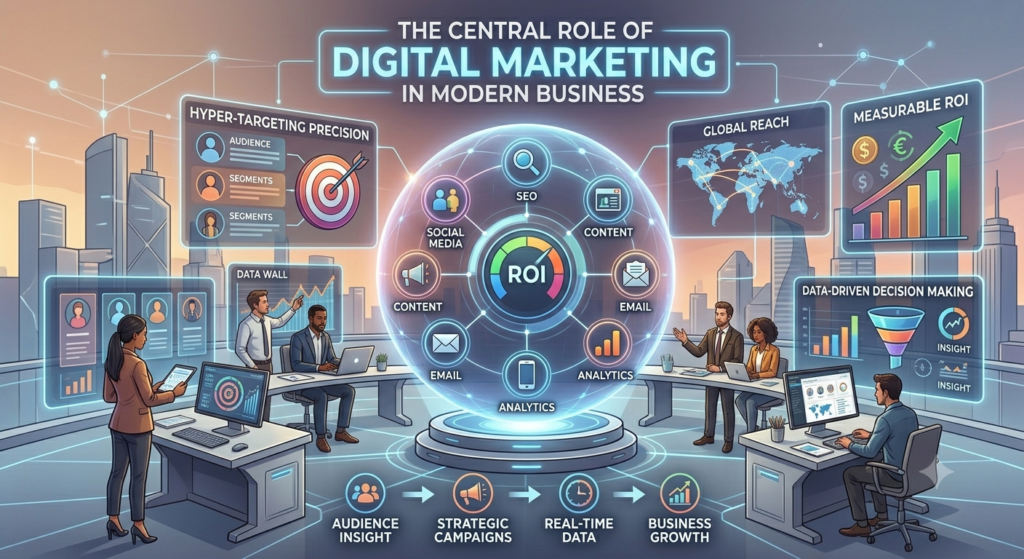
1. The Shift from Traditional to Digital Marketing
For decades, businesses relied heavily on print ads, billboards, television, and radio to broadcast their message. While these mediums had their golden era, they share a massive flaw: they are a one-way street. Traditional marketing casts a wide, expensive net, hoping to catch a few interested buyers, but offers very little data on who actually paid attention.
Digital marketing flipped this old playbook upside down. It introduced a two-way conversation between brands and consumers. Instead of guessing how many people saw a billboard on a highway, businesses can now track every click, view, share, and purchase in real-time. This shift has democratized business, allowing small startups to compete on the exact same digital stage as multi-billion-dollar corporations.
2. Breaking Geographical Barriers: Global Reach at Your Fingertips
Historically, expanding a business meant physical expansion—opening new brick-and-mortar stores, hiring local staff, and dealing with international logistics. This required immense capital and carried massive risks.
Digital marketing has effectively erased borders. A small artisan business operating out of a home garage can sell products to a customer thousands of miles away with nothing more than a well-optimized website and a targeted social media campaign.
Through Search Engine Optimization (SEO) and global social media platforms like Instagram, LinkedIn, and TikTok, businesses can establish an international footprint overnight. The world is no longer divided by geography; it is connected by interests and search queries.
3. Hyper-Targeting: Reaching the Right Audience
One of the most powerful aspects of digital marketing is its surgical precision. In traditional advertising, if you buy a TV commercial spot, you pay to show your product to everyone—including people who have absolutely no interest in what you sell. This leads to massive budget wastage.
Digital marketing platforms utilize sophisticated data analytics to ensure your ad spend is hyper-focused. Businesses can target potential customers based on:
- Demographics: Age, gender, location, income level, and education.
- Psychographics: Interests, hobbies, values, and lifestyle choices.
- Behavioral Data: Past purchase history, websites visited, and search intent.
For example, a company selling eco-friendly vegan running shoes can specifically show ads to “25-to-40-year-olds living in urban areas who have recently searched for sustainable fitness gear.” This level of targeting ensures that marketing messages land in front of the people most likely to buy, drastically increasing conversion rates.
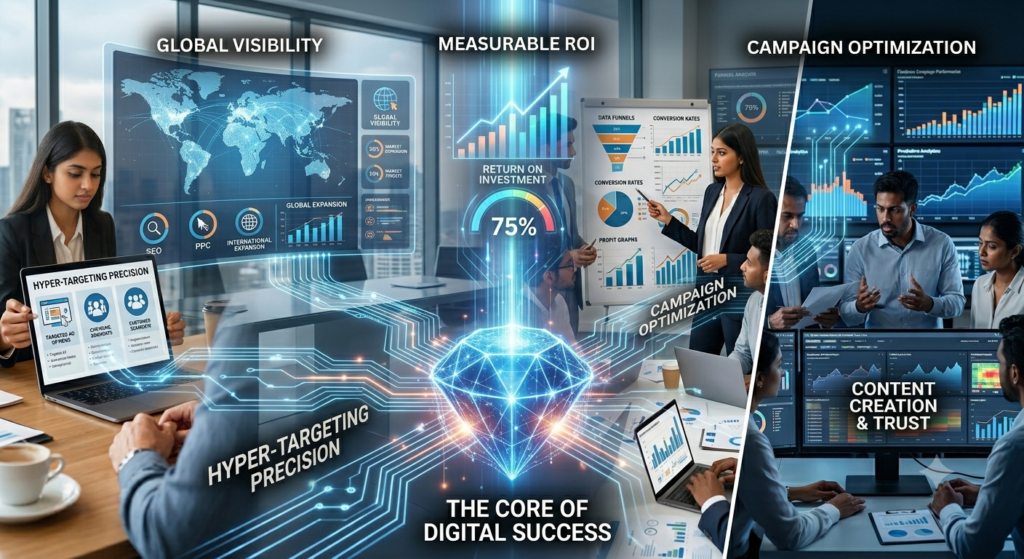
4. Cost-Effectiveness and High Return on Investment (ROI)
For small and medium-sized enterprises (SMEs), budget constraints are a constant battle. Television slots and prime billboard spaces are prohibitively expensive. Digital marketing, however, accommodates budgets of all sizes.
Whether a business has $50 or $50,000 to spend, digital channels offer scalable solutions. Pay-Per-Click (PPC) advertising, for instance, ensures that a business only pays when a user actually clicks on their ad.
Furthermore, organic strategies like content marketing and SEO require time and effort rather than heavy financial investment, yielding compounding returns over the long term. Because every dollar spent can be tracked directly to a lead or a sale, businesses can optimize their campaigns on the fly, cutting out underperforming ads and scaling up winning strategies to maximize ROI.
5. Building Brand Authority and Consumer Trust
Modern consumers are highly skeptical. Before making a purchase, they look for social proof, online reviews, and a credible web presence. Digital marketing allows businesses to build a narrative and establish themselves as industry leaders through valuable content.
By consistently publishing informative blog posts, hosting webinars, creating engaging videos, and maintaining active social media profiles, a business can demonstrate its expertise. When a brand provides free value and answers consumer pain points before even asking for a sale, it builds deep emotional trust. In the digital age, a business is no longer just what it sells; it is the value and community it creates online.
6. The Power of Data-Driven Decision Making
In the past, measuring the success of a marketing campaign involved a lot of guesswork and delayed feedback. Digital marketing provides instant gratification through data analytics. Tools like Google Analytics, Meta Pixel, and CRM software offer a transparent look into consumer behavior.
Business owners can instantly see:
- How many people visited their website.
- Which specific pages they spent the most time on.
- At what exact stage they abandoned their shopping carts.
- Which ad copy resonated best with the audience.
This continuous stream of data eliminates emotional guesswork. If a campaign isn’t working, it can be tweaked, paused, or completely reinvented within minutes, saving businesses from costly long-term mistakes.
7. Customer Engagement and Interactive Personalization
Modern marketing is no longer about shouting at your customers; it is about conversing with them. Digital marketing channels offer unparalleled opportunities for direct engagement. Consumers can comment on posts, send direct messages, leave reviews, and participate in live Q&A sessions.
This instant interaction humanizes a brand. When a business responds to a comment or resolves a customer complaint publicly on social media, it shows that they care.
Furthermore, digital marketing allows for deeply personalized experiences. Automation tools can send tailored email sequences addressing the customer by their first name, recommending products based on their past browsing history, or offering a special discount on their birthday. This level of personalization makes consumers feel valued, fostering long-term brand loyalty.
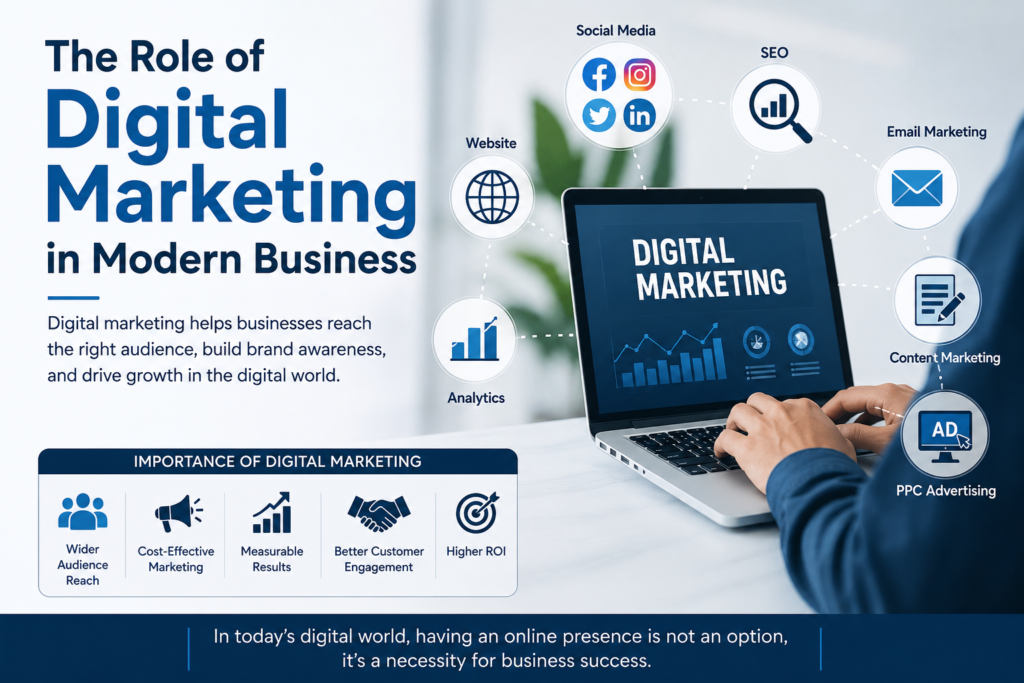
8. Adapting to the Mobile-First Consumer
The modern consumer is inseparable from their smartphone. From checking reviews while standing in a physical aisle to purchasing groceries on the subway, mobile devices dictate consumer habits.
Digital marketing ensures that a business is visible exactly where the consumer is looking. Mobile-optimized websites, SMS marketing, location-based targeted ads, and frictionless mobile checkout systems allow businesses to capture micro-moments of high buying intent. If a business fails to optimize its digital presence for mobile users, it effectively shuts the door on more than half of its potential market.
Conclusion
The digital revolution has permanently rewritten the rules of commerce. Digital marketing is no longer a luxury reserved for tech startups or massive corporations; it is a fundamental pillar of modern business operations. By offering global reach, precision targeting, cost-effective scalability, and invaluable data insights, it empowers businesses to connect with audiences in deeply meaningful ways. In a marketplace that moves at the speed of a swipe, embracing digital marketing is the only definitive way to transform a business from a hidden entity into an unforgettable brand.